Thursday, August 9, 2012

My Finished Living Space

A few months ago I found a nice shady spot near my tent that I began setting up as a living area. It started with just a few camp chairs and a tiki torch. Then I added a hammock, which was a huge improvement. I've spent many hours in that hammock already. Next came a picnic table. Then a camp stove and a fire ring. And finally I built a frame and added a wooden swing.

My "living room"

The hammock gets a lot of use
I love this space. I often have friends over for dinner and drinks and we spend most of our time down here. I keep a cooler at the picnic table and fill it with ice when I entertain. This area is about 20 yards from my tent and I've made a path and lined it with tiki torches. It's so nice at night. I'll bring down my CD player and do some outdoor cooking. Grilled sweet corn, fish, or steaks. Fresh vegetables. Goat cheese and bread warmed on the coals. I've even brought down the camp oven and made grilled steak nachos with fresh guacamole. And always plenty of beer on ice. And a hammock calling out my name. It's my favorite "room".

Monday, August 6, 2012

FAIL!: Rain Fly Support System, Version 2.0

A few weeks ago, I complete my new, re-designed rain fly support system. The support system consisted of two vertical 4x4 posts and a horizontal 25-foot cross piece running from post to post. I built the cross piece using doubled-up 1x8s, face-bolted together. I staggered the joints so that they were 4 feet apart.

The finished board was 1-1/2" thick x 7-1/4" tall x 300" long (that is, 25'). It was a ribbon of a board, and when you picked up one end the tried to get it to stand on edge, it would inevitably twist and turn and lay down flat at the other end. I was a little concerned about this behavior because I needed the board to stand on edge once I fastened it to the posts.

When I first installed the cross piece, it had a nice, gentle twist to the right. It sort of reminded me of the pleasant lines taken by wooden strakes on a rowboat. But I didn't want this thing to glide through water, I wanted it to stand up on edge. My good friend, Tom, who helped me put the board in place said, "You'll never get the twist out of that thing." Well, maybe, but I was still gonna try my best.

I attached a few ropes at different locations on the board and pulled and tugged as needed to get the board to stand up on edge. I finally got it pretty close and staked the ropes in place.

The board would hold its position for about a day before slowly sagging and twisting in a new direction. So I'd pull and tug and stake out the ropes again, only to have the board twist at yet another place a day or so later. This cat-and-mouse game continued for awhile. Then, a few days ago, I was trying to straighten out a particularly nasty twist and heard a "crack!" I peaked under the rain fly and saw exactly what I didn't want to see. One of the joints had cracked. And with that bad joint, there was no way the board would handle any sort of a snow load this winter.

Failed joint in the 25-foot cross piece
Well, turns out Tom was right. I couldn't get that thing straightened out. I'm leaving the board in place for now, since it's still fine during the summer when there's no snow. The rain fly has quite a sag, but it's still sheds rain just fine, and it offers much needed shade on these hot summer days.
Twisted cross piece and saggy rain fly
Okay, okay, so let me be the first to say it: FAIL! I guess it's back to the drawing board (and I already have some ideas for Version 3.0).

Friday, August 3, 2012

Completed Rain Fly Provides Welcome Shade

A few weeks ago, I complete my rain fly support system. The support system consists of two 4x4 posts, one in front and the other in back of the tent, with a 25-foot board running parallel to the roof ridge from the top of one post to the top of the other.

Completed support system
With the support system in place, the final step was to drape the tarp over the cross piece, spread it out flat, and stake it down. I fastened metal conduit to the eaves of the rain fly using nylon zip ties. That kept the lines straight so that water would shed properly, and spread the tension across the full set of grommets instead of just a few.

Tarp in place
I designed the support system such that the rain fly would be 2 to 3 feet above the peak of the tent roof. That would keep the hot summer air away from the tent. The rain fly would act as a big shade tree in the summer. And it worked better than expected. The shading effect has reduced my interior temperature by more than 15 degrees. Now, when it's 95 degrees outside and the summer sun is directly overhead, it only reaches perhaps 97 or 98 degrees inside the tent.

Two-foot gap between tent and rain fly allows air to circulate

Tuesday, July 31, 2012

The Work We're Designed To Do

Doctors. Lawyers. Executives. Engineers. Information technologists. Prestigious white-collared folks with money. Successful people. People that are role-models for our children. Consider the nature of their work. "Work with your head, not your hands!", we're advised. But look at what these "dream jobs" do to our bodies and to our spirits.

Our bodies are designed to be used. Lifting weight makes us stronger. Walking keeps our heart and lungs healthy. We're design to stay physically active throughout our lives. Sitting at a desk eight hours each day is bad for our bodies.

And what about our minds? Try doing some mindless, physical, repetitive work for an extended period, like digging a trench or pulling weeds, and notice how the mind enters a relaxed state of wandering. How the mind and the body begin to harmonize. The mind begins to notice the body as much as it notices the tasks being performed. It hears the sound of the shovel entering the soil, and also the sound of breathing. It feels the soreness of the hands, and also the pounding of the heart. The mind, the body, and the work become one. It's called being "in the zone", and it's a relaxed state without stress.

Now, leave that sort of physical labor behind for a moment, and let your imagination enter an office job. Read some emails. Attend a meeting. Solve a technical problem. Interact with your co-workers. Talk to your manager. And while you're doing all of that, sit in a chair in a sterile, air conditioned office. Are you even aware of your body?

There are good jobs and bad jobs. But which are which? That depends upon your values and the trade-offs you make between money and stress and health. One thing is for certain, our bodies aren't very good at office work, and our minds aren't very good at it either, considering the amount of stress it brings. Our minds and bodies are designed to garden, and gather food, and build simple structures using our hands. We don't like "bosses", but we appreciate helpers and wise friends with good advice. We like small undertakings that satisfy basic needs, like picking tomatoes when they are ripe. But unnecessary activities done just for the sake of money, like producing unnecessary consumer goods in a plastics factory, leaves us feeling empty.

We've come a long way from the 20-hour work week of our ancestors. And the path that we took was all about man-made objects. Well we've apparently succeeded because most of us now spend our days working to provide goods and services that are not really needed at all. They're unnecessary niceties. And having been on this path now for so many generations, we've all but forgotten the type of work that we were actually meant to do. And even worse, we continue to teach our children that mindless, physical, repetitive work is for losers. "Work with your head, not your hands!", we tell them, from our easy chair, while we watch too much TV, and eat too much pre-processed food, and wait and worry about tomorrow and how our day will go at work.

Wednesday, July 25, 2012

Living a Stress-free Lifestyle

There have been times in my life when I've felt stress. A lot of stress. Days filled with activities I didn't want to do but which had to get done. Sleepless nights when I couldn't quiet my mind. Times when I would worry about things that were out of my control. Like when my roof had serious leaks that I couldn't afford to repair, and it would rain. Or when I almost lost my job. Or when a tree blew down in a storm and cost me over $1000 to get removed. The stress of having to do too many things that I didn't really enjoy, and not having time to follow my passions. The stress of living an expensive lifestyle in which there never seemed to be enough money. The stress of having to maintain the things that I had already acquired, while trying to figure out how to acquire even more.

I used to tell myself that all that stress was just a frame of mind. That I could meditate and practice mindfulness and learn to relax. And in fact I did, to a large extent. But I wasn't very good at it. And I would become a bit numb as I entered a mindful state, observing my stress from a faraway mind, but also having to observe my joys from afar instead of feeling them. It was a good coping mechanism, but then again, so was sleep.

When I first started living in a tent, I figured it would be less stressful. But I never imagined it could be like this. My life is so carefree. I have nothing to do, and all day to do it. I have no lawn. I own no property. I have no bills. My tent needs no maintenance. My systems are so cheap and simple that I never worry about failures. I don't have insurance because there's nothing of value to lose. I don't worry about losing my job because I don't need the money anyway. My life is simple, and I am free.

The modern lifestyle is stressful because it's nice and comfortable and those comforts and niceties comes at a price. I've walked away from comfort, and no longer have to pay that price. Now I sit around on hot summer days, sweating because there's no AC, deer flies buzzing around my head, relaxed and smiling. Thinking about how, when night falls, I'm gonna sleep soundly without a worry in the world. I take long naps on rainy days. I play my guitar and sing. I sit and listen to the birds and insects. I swing on my hammock and sing to the trees around me.

My current lifestyle feels like being on vacation and I'm completely enjoying it. I deserve a carefree life, as we all do. It's the natural state of mankind on this planet, and we can all still choose to live free anytime we wish. I've opted out of the modern lifestyle. It was bad for my spirit. I can go back anytime I wish but I won't anytime soon. I much prefer tent living.

Monday, July 23, 2012

Rain Fly Support System, Version 2.0

I finally put up my new, re-designed rain fly support system. It's taken a while, but I'm pretty pleased with the results so far. The idea was to mount the rain fly 2 to 3 feet above the peak of the tent roof, thereby keeping hot summer air away from the tent roof. The rain fly would act as a big shade tree in the summer.

The support system consists of two 4x4 posts, one in front and the other in back, with a 25-foot board running parallel to the roof ridge from the top of one post to the top of the other. The top of the posts are about 3 feet above the peak of the roof which gives the desired clearance for air circulation.

Detailed architectural blue print of the design :)
I pieced together the 25-foot cross piece using doubled-up 1x8s. I face-bolted the 1x8s together using carriage bolts, and staggered the joints. I used 8- and 12-foot 1x8s so that the nearest joints were at least 4 feet apart.
25-foot cross piece built-up from sistered 1x8s through-bolted with carriage bolts
Next, I planed a crown into the top of the cross piece so that the sharp edges didn't wear through the rain fly.

Smoothing the top edge of the cross piece
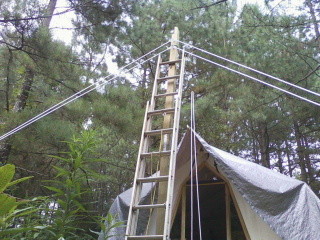
Now, how to erect the support system? One of the posts is over 14 feet tall. It's quite a lot to handle by myself, but I tried. I attached the guy-lines to the post and then fastened them to the stakes. I then started walking the post up. It went up surprisingly easily.

Raising the post
Then for the next step: I set the post nearly vertically, leaning it toward the tent just enough to keep a bit of tension on the guy-lines. Then, I leaned my 24-foot extension ladder against the post and started to climb up (not shown). This all looked good on paper :) I'd just climb on up to the top, hoist up the cross piece, fasten it, move on to the other post, and repeat the process. Easy, right? Wrong! It was scary as hell up there! Fourteen feet off the ground and everything moving around! Abort! Abort!

I was about to give up on doing this job solo but figured I'd try one more thing. I'd put up both posts, tie a rope from the top of one to the top of the other, then add tension to the guy-lines in front and rear. Maybe this would stabilize the whole system.

Front and rear posts both in place, temporarily connected by a rope

Front post after stabilizing the system
This time things were much more stable and I felt much safer climbed up the ladder. The next step was to hoist the cross piece to the top of the posts and bolt it into place. I draped two ropes over the horizontal rope that joined the two posts, then tied them off to the ends of the cross piece and hoisted it up as far as I could.

Cross piece tied off and resting on the roof, nearly in place
I climbed up the ladder again to see whether I could grab the end of the cross piece and set it in place. I started to pick up the cross piece, very slowly, very deliberately. Once again, things started moving as I picked up the heavy cross piece and starting shifting weight around. My ladder loaded up with the new weight and pushed harder against the post. The horizontal rope between the posts off-loaded weight which created slack and allowed both posts to move a bit more. And as I was reaching out and down with my left hand to pick up the cross piece, the ladder twisted on the narrow 4 x 4 posts that it was resting on. To counteract the twist, I grabbed the guy-lines on the right-hand side with my right hand. Slowly, I kept lifting the cross piece, making fine adjustments with my feet, shifting my weight, pulling on the guy-lines. Slowly. Slowly. Inch by inch.

Then a thought ran through my head, "You don't have a cell phone signal out here." Why was I thinking about cell phone signals? Because I figured I might have to make a call. To 911. Because I had fallen. While doing something stupid on a 14-foot ladder. Hey, dummy, stop!

I lowered the cross piece. Slowly. Slowly. Until it was resting again on the roof. Then I climbed down the ladder, took a deep breath, and waited for my heart rate to return to normal.

Hmmm, now what? I pondered different ways of getting the cross piece into place by myself but finally decided I needed help. I was able to place the ladder against the short post in the rear, raise the cross piece into place, and slip a single bolt through to fasten it to the rear post. But that was the end of my solo attempt.

A few days later my good friends Tom and Ian were visiting and offered to help put the cross piece in place. I once again leaned the ladder against the tall post and climbed up while Ian stood below and steadied things, keeping me safe. Tom stayed below, too, and used a long notched board to capture the cross piece and slowly raise it into place. Ian handed me a hammer which I used to persuade the cross piece to align with the holes in the post while I slipped the bolts into place.

I got down from the ladder and walked around the tent to inspect the results. Everything looked pretty good. The cross piece had a pretty bad twist, but the posts still had to be plumbed and the guy lines tightened, which would take some of the twist out.

Cross piece bolted in place

Tuesday, July 17, 2012

Preparing for Armageddon

Is "the end" near? A lot of people think so. And some people see my current lifestyle as a statement about being prepared for the end of civilization. While I don't worry much about WWIII or alien invasions or killer asteroids, I do think about other types of failures. Like economic collapse. Or infrastructure failures that could impact our food or energy supplies.

I suppose in a way I've already "jumped ship", and have fashioned a life raft that in many ways feels more secure than the old mother ship. My home is 100% off the grid. I have no mortgage, and my rent is so cheap that I pay a full year in advance. My total utility bills for water, sewage, lighting, cooling, and heat, are under $20 per month. I live in the woods, and my home doesn't have a physical address.

I don't have a large cache of food, but I'm okay if the power grid fails. I can't survive a nuclear attack, but I can weather a complete financial collapse pretty well since I don't have any debt and I need very little income to keep my home operational.

In fact, my current lifestyle meets my physiological and safety needs much better then my old conventional lifestyle. I feel very secure financially. I don't need my current job. I'm healthy. And I'm at peace.

Maslow's hierarchy of needs
 Am I prepared for "the end"? Well I suppose it depends on what the end looks like. I can weather some pretty good storms now. On the other hand, did I jump ship too early? I don't think so. My heart feels so damn good out here. And I know I'm good for one more year for sure, maybe more.